

Table of Contents
What is Falkenberg Drill?
The Falkenberg drill is a renowned drill in table tennis, popularized by Stellan Bengsston and players at Sweden’s Falkenberg table tennis club in the 1970s and hence the name, Falkenberg drill.
How Falkenberg Drill works?
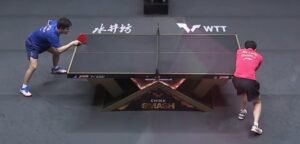
The drill typically involves a feeder directing balls—usually using their backhand—to the player’s backhand twice. On the first feed, the player plays a backhand shot, and on the second feed, they transition to their backhand side to play a forehand shot. Then, the feeder directs a third ball to the forehand side, requiring the player to sidestep to the wide forehand side and hit the ball with a forehand.
Here’s Tashiya Piyadasa doing the Falkenberg drill. Tayisha is a Sri-Lankan American table tennis player who become a national champion in the USA.
Advantages of the the Falkenberg drill
The Falkenberg drill encourages significant court movements as you get to move to your wide forehand and backhand side. This also enhances player’s agility and fitness while improving balance and power shot by maintaining a low center of gravity. Since it’s a repetitive drill, players can focus on their placement, power, and speed.
Variations
Placement
For beginners, the placement of the balls can be narrowed while the player is still developing the strength leg and the speed of his feet. Once he can move with ease, the balls can be directed on wide forehand and backhand.
Speed
The speed of the ball can be adjusted specially for players who still has not refined their strokes. It is important that players have the proper stroke and posture because those are very hard to correct later on if have incorporated them as a bad habit.
Spin
The spin can also be varied. For example, the first feed can be an underspin forcing the player to do backhand loop. This variation can simulate real game scenarios.

Been playing since 9 years old and now mostly for hobby. Also do software on the sideline for fun.